

The Power of Framing: Why BigConfig is Rebranding as a Package Manager
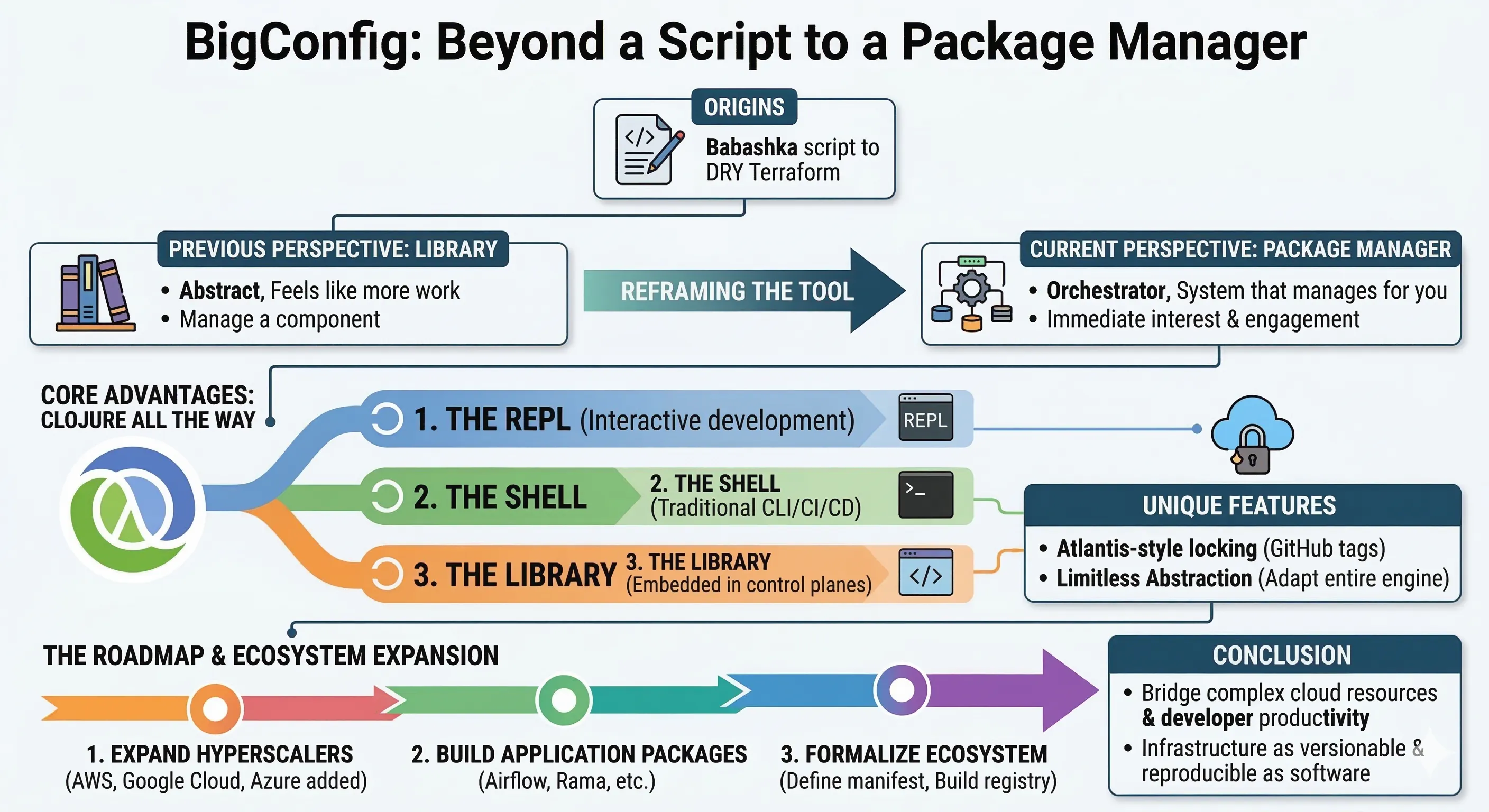

BigConfig began as a simple Babashka script designed to DRY up a complex Terraform project for a data platform. Since those humble beginnings, it has evolved through several iterations into a robust template and workflow engine. But as the tool matured, I realized that technical power wasn’t enough; the way it was framed was the true barrier to adoption.
The Language Barrier (and the Loophole)
Section titled “The Language Barrier (and the Loophole)”BigConfig is powerful as a library, but I’ve faced a hard truth: very few developers will learn a language like Clojure just to use a library. However, history shows that developers will learn a new language if it solves a fundamental deployment problem.
People learned Ruby to master Homebrew ; they learn Nix for reproducible builds. Meanwhile, tools like Helm force users to juggle the awkward marriage of YAML and Go templates—a “solution” many endure only because no better alternative exists. To get developers to cross the language barrier, you have to offer more than a tool; you have to offer a total solution.
The “Package Manager” Epiphany
Section titled “The “Package Manager” Epiphany”I noticed a significant shift in engagement depending on how I framed the project. When I describe BigConfig as a library, it feels abstract—like “more work” added to a developer’s plate. When I introduce it as a package manager, the interest is immediate.
In the mind of a developer, a library is a component you have to manage. A package manager is the system that manages things for you. By shifting the perspective, BigConfig goes from being a “Clojure utility” to an “Infrastructure Orchestrator.”
How BigConfig Differs
Section titled “How BigConfig Differs”Like Nix and Guix , BigConfig embraces a full programming language. However, it avoids the “two-language architecture” common in those ecosystems—where you often have a compiled language for the CLI and a separate interpreted one for the user.
BigConfig is Clojure all the way down (in the spirirt of Emacs). This allows it to support three distinct environments seamlessly:
- The REPL: For interactive development and real-time exploration.
- The Shell: For traditional CLI workflows and CI/CD pipelines.
- The Library: For embedding directly into your own control planes or APIs.
Beyond the language, BigConfig introduces robust client-side coordination, featuring an Atlantis-style locking mechanism that uses GitHub tags to prevent developer collisions in shared environments.
Limitless Abstraction
Section titled “Limitless Abstraction”The level of abstraction is where BigConfig truly shines. When you adopt the system, you aren’t locked into a rigid schema; you can adapt the entire engine to your specific needs. Complex tasks—like deploying the same architecture across different hyperscalers—are reduced from massive refactors to simply updating a property. It moves the conversation from how to deploy to what to deploy.
The Roadmap
Section titled “The Roadmap”The next phase is focused on expanding the ecosystem and making package discovery seamless:
- Hyperscaler Support: Having already added DigitalOcean , Hetzner , and Oracle Cloud , I am now prioritizing AWS , Google Cloud , and Azure .
- Application Packages: While the first “app”—a remote development environment—is a niche use case, I’m expanding into high-demand stacks like Airflow and Rama .
- The Ecosystem: I am currently defining the formal package manifest and building a registry where users can discover, version, and publish their own infrastructure packages.
Conclusion
Section titled “Conclusion”The evolution of BigConfig is a testament to the idea that the right abstraction is just as important as the right code. By reframing the tool from a utility you have to manage into a system that manages for you, we bridge the gap between complex cloud resources and developer productivity.
As we expand our hyperscaler support and formalize our package registry, the goal remains the same: to move infrastructure management away from the “how” and toward the “what.” Whether you are deploying a niche remote environment or a massive data stack like a Data Lake, BigConfig provides the language and the logic to make your infrastructure as versionable and reproducible as your software.
Would you like to have a follow-up on this topic? What are your thoughts? I’d love to hear your experiences.